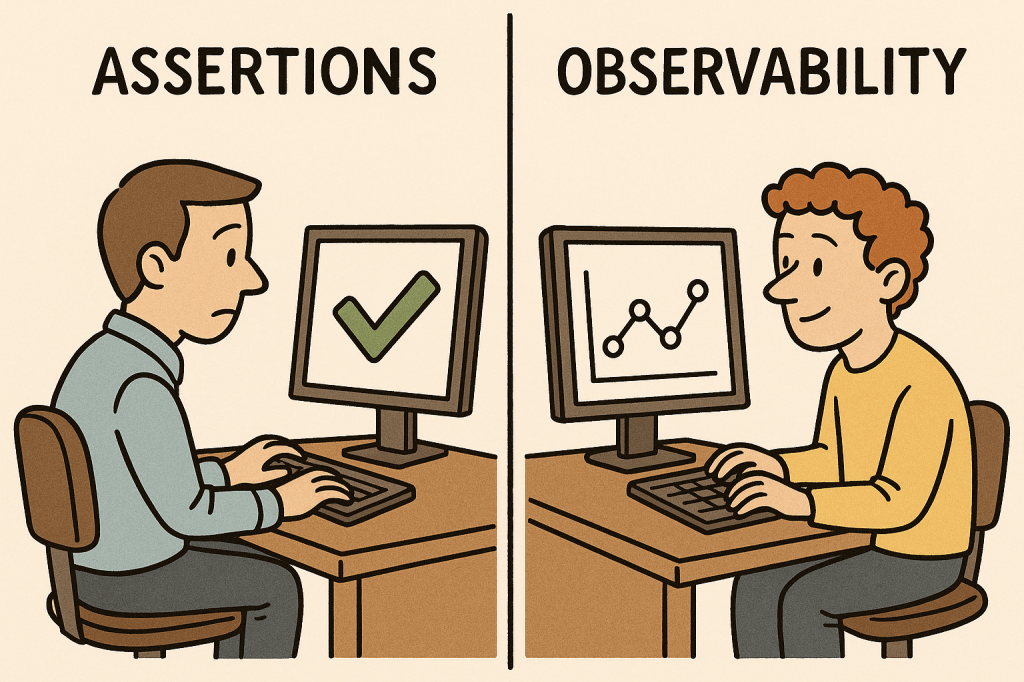
“Assertions validate outcomes. Observability validates understanding.”
What’s at Stake When Software Outgrows Binary Testing?
For decades, test engineering has revolved around assertions — verifying whether what we expected actually happened.
assertEqual(actual, expected)
A green checkmark meant success. But software today is no longer binary. Distributed systems, AI models, and autonomous agents behave probabilistically, contextually, and often non-deterministically.
Assertions still tell us if something broke, but not why, how often, or how badly the system is degrading over time.
Why Do Assertions Alone Fall Short in Modern Systems?
When was the last time an assertion caught the story behind a flaky test or a subtle drift?
def test_checkout_total():
    cart_total = calculate_total(cart)
    assert cart_total == 49.99
But what if pricing logic flexes with ML predictions or personalized offers?
- Can a simple assert track ongoing model drift?
- Can it reveal if latency spikes are hurting user experience?
- Does it capture how recommendation changes affect outcomes?
Assertions validate outcomes, but do they truly capture dynamic behavior?
Should We Shift from Assertions to Signals in Testing?
What if, instead of relying on fixed truths, we watch for signals and patterns?
- How would observability-driven testing change our understanding of system health?
- Could trends and outliers tell us more than a steady parade of passing tests?
# Pseudo-observability check
trace = get_trace("checkout_flow", session_id)
latency = trace.metric("service_latency_ms")
discount_variance = trace.metric("discount_variance")

assert latency < 500               # traditional
observe("discount_variance", trend_over="24h", threshold=0.05)  # signal-based
Now, instead of one static assertion, we continuously observe the system’s metrics and trends.
We’re not only testing correctness — we’re testing stability and consistency.
What Happens When Tests Think for Themselves?
As AI agents self-adapt and self-heal, should our tests do more than follow predetermined scripts?
What if they could learn what matters, detect anomalies, and create new test cases?
agent = TestAgent()
signals = agent.collect_observability_signals(app="checkout")

if agent.detect_anomaly(signals):
    agent.create_test_case(
        name="RegressionCheck_DiscountModel",
        hypothesis="Discount variance > baseline by 5%",
        remediation="Retrain discount_model_v2"
    )
This is where testing and reasoning start to merge — systems validating themselves through context.
Moving Beyond — Not Without — Assertions
Assertions will always anchor truth.
Signals can guide direction.
assertEqual(status_code, 200)
observe("cpu_usage", "<80%")
observe("ai_response_confidence", ">0.85")
The next evolution isn’t about abandoning assertions — it’s about expanding them with awareness.
What Mindset Will Define Tomorrow’s Test Engineer?
If our systems can think, our tests must interpret.
If our models can adapt, our validations must evolve.
Tomorrow’s test engineer will:
- Trace not just logs, but reasoning paths.
- Compare signal patterns instead of single values.
- Use AI agents to maintain evolving coverage.
- Measure confidence, not just pass/fail.
Where Do We Go from Here?
Beyond Assertions isn’t about leaving behind what we know — it’s about expanding what we observe.
The future of testing is not binary; it’s contextual, continuous, and collaborative between humans and intelligent systems.
Let’s explore that future — one signal at a time.
 BeyondAssertions
Leave a comment